
Hula Grass Skirts: The Surprising History Behind Hawaii’s Most Famous Costume

The “grass skirt”
The Image Everyone Knows
Close your eyes and picture a hula dancer. You see it, right? The swaying hips, the flower lei, and that skirt. Thousands of golden strands cascading with every movement. The image is so embedded in global consciousness that it might as well be a universal symbol for the Hawaiian Islands.
Here’s the thing. That skirt? It’s not ancient. It’s not even originally Hawaiian.
But that doesn’t make it meaningless. The story of the hula grass skirt is the story of Hawaii itself: layers of culture, eras of reinvention, and a people who absorbed outside influences while keeping their roots intact.
We’re going to untangle this. Not to debunk or diminish, but to give you the full picture so that when you see a dancer perform, you understand what you’re witnessing.
Where Did the “Grass Skirt” Actually Come From?
The skirt that launched a thousand postcards arrived in Hawaii from Kiribati, the Gilbert Islands, sometime in the late 1800s. Polynesian voyagers and Pacific trade routes moved people, goods, and fashion across vast ocean distances. The Gilbertese “grass” skirts, made from dried pandanus or coconut fibers, caught on.
Then Vaudeville got hold of it.
By the early 1900s, mainland stages featured “Hawaiian” acts that leaned into exotic spectacle. The grass skirt photographed well. It moved dramatically. It rustled. Audiences loved it, and the image calcified into American pop culture.
The Boat Days of the 1920s through 1950s cemented the association. Steamship passengers arriving at Honolulu Harbor were greeted by dancers in these skirts, lei sellers, and ukulele serenades. This was the era of Waikiki as playground, of “Lovely Hula Hands” and Don Ho. The Golden Era. The “grass skirt” became its uniform.
None of this diminishes the joy those skirts brought to dancers and audiences alike. But it does mean the image in your head is about 150 years old, not 1,500.
What Are Hula Skirts Really Made Of?
Let’s clear up a small absurdity. “Grass skirt” is a misnomer. Nobody is weaving lawn clippings into dancewear.
The modern paʻu you see in nostalgic performances is typically made from Hau bark (a native hibiscus), raffia fiber, or cellophane. That distinctive theatrical rustle? Often synthetic. The sheen catches stage lights better.
The term paʻu simply means skirt. It doesn’t specify material. So when we talk about “authentic Hawaiian dance outfit,” we’re really asking: from which era?
The Ancient Paʻu: Ti Leaf and Kapa
Before Western contact, before Gilbert Islands influence, before Hollywood, Hawaiian dancers wore what the land provided.
The ti plant (Cordyline fruticosa) grows across the islands. Hawaiians called its leaves lāʻī and used them for everything from food wrapping to spiritual protection. For hula, fresh green ti leaves were gathered, sometimes that same morning, and tied at the waist. The skirt lived. It smelled of earth and chlorophyll. It would wilt within days. This was intentional.
The ti leaf skirt was not a costume. It was an offering. Made fresh for the ceremony, worn during the sacred, then returned to the ʻāina (land).
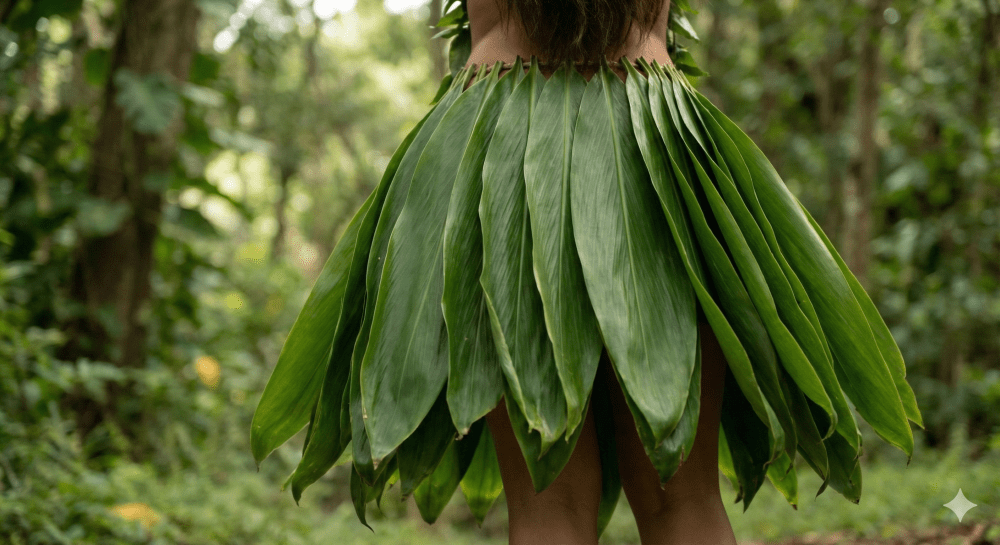
Ti Leaf Skirt
Kapa, the bark cloth beaten from wauke (paper mulberry), served more formal purposes. Decorated with geometric patterns using plant dyes, kapa paʻu wrapped the hips in fabric that carried the geometric language of Hawaiian visual culture. Making kapa required weeks of soaking, beating, and finishing. These garments were precious.
When you watch Hula Kahiko, the ancient style, you are looking at this tradition. The dancers’ skirts honor what their ancestors wore when hula was not entertainment but prayer.
The Sound Tells the Story
Here is something you will never forget once you hear it.
A Golden Era skirt swishes. Sharp, bright, theatrical. The sound cuts through music. It announces itself. This is performance. This is spectacle. This is Boat Days Waikiki, welcoming the world.
A fresh ti leaf skirt rustles. Softer. Earthier. The sound of leaves moving against each other, almost a whisper. This is Kahiko. This is invocation. This is a conversation between dancer and akua (gods).
At a lūʻau that honors both traditions, you hear the difference within the same evening. The shift in sound signals the shift in era, in purpose, in spiritual weight.
Why the Skirt Moves: The Uwehe Connection
Hula lives in the hips. The uwehe, that signature double knee-bend with hip lift, is the engine of the dance. The feet stay grounded. The upper body remains controlled. But the hips? They articulate the mele (song), punctuate the poetry, and carry the story forward.
The paʻu exists to make this visible.
A ti leaf skirt follows the hip with organic delay. The leaves trail the movement by a fraction of a second, creating visual echo. The dancer moves. The skirt responds.
The Golden Era skirt amplifies. Thousands of strands fly outward on each uwehe, catching light, creating drama. This is why Vaudeville adopted it. Maximum visual impact.
Neither is “better.” They serve different functions. One whispers. One shouts. The dancer chooses what the moment requires.
Two Eras, One Evening at Pāʻina Waikīkī
We perform on Hamohamo, the royal summer grounds of Queen Liliʻuokalani. Her homes, Kealohalani and Paoakalani, once stood where you’ll sit sipping your Mai Tai. This land holds layers of history, and our show, produced by Tihati Productions, honors them.
The evening begins with Kahiko. You’ll see dancers in fresh ti leaf and kapa-inspired attire. The oli (chants) are ancient. The movement is grounded. This is hula as it existed before ships arrived.
Then the show transitions through the Auana era, the monarchy period when hula absorbed Western melody and instrumentation. Here come the nostalgic styles. Here come the swishy skirts of Boat Days. The hapa haole songs. The dreamy, romantic vision of Hawaii that your grandparents fell in love with.
We don’t ask you to choose. Both exist. Both matter. The grass skirt is a beloved icon of a specific moment in Hawaiian cultural history. The ti leaf skirt carries older mana (spiritual power). At Pāʻina, we set both before you and let the dancers show you why each belongs.
The evening ends with Siva Afi, the Samoan fire knife dance. Different island tradition entirely. But that’s another history lesson.
Beloved Icon, Deeper Roots
The hula grass skirt doesn’t need defending or dismissing. It’s a nostalgic artifact of Hawaii’s 20th-century reinvention, a symbol of the era when the islands became synonymous with tropical escape. Millions of people discovered aloha through that image. The joy was real.
The ti leaf and kapa paʻu don’t need rescuing from obscurity. They’re alive in every Kahiko performance, honored by kumu hula across the islands, taught to keiki in hālau (hula schools) that trace their lineages back generations.
What matters is knowing the difference. Recognizing which story you’re watching unfold. Hearing the shift in sound when the music changes from ancient chant to Golden Era melody.
Come to Hamohamo. Sit on the Queen’s grounds. Watch the dancers move through centuries in a single evening. And when the paʻu swishes or rustles, you’ll understand exactly what you’re hearing.
FAQs
Why did the grass skirt become more famous than the ti leaf skirt? Photography, Vaudeville, and the Boat Days tourism boom of the 1920s-1950s. The Golden Era grass skirt was theatrical and photogenic. It moved dramatically on stage. Ti leaf skirts, made fresh and temporary, didn’t photograph as well or survive as artifacts. The grass skirt became the image because it could be reproduced, shipped, and performed night after night.
Can you still see authentic ti leaf skirts in Hawaii today? Absolutely. Hula Kahiko performances at competitions like Merrie Monarch feature dancers in fresh ti leaf and traditional kapa. At Pāʻina Waikīkī, our Kahiko segment opens with dancers in these traditional materials before transitioning to later era styles.
Is it disrespectful to wear a “grass skirt” to a lūʻau? Not inherently. The Golden Era grass skirt is a piece of Hawaiian pop culture history, and many local families associate it with fond memories of Waikiki’s heyday. The key is context: wearing it playfully at a tourist lūʻau differs from wearing it to a sacred ceremony. When in doubt, ask. Hawaiians appreciate guests who approach their culture with curiosity rather than assumptions.